| |||
| Dance Festival in Chicago To mark 30th anniversary of Natya Dance Theatre |
  | ||
| By V. R. Devika arts activist and cultural organizer. Devika led a team of artistes from south India to the Chicago festival
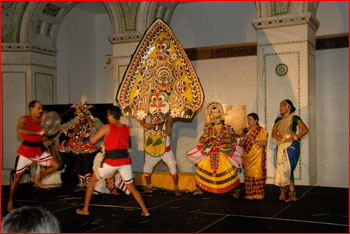
We were very happy to have brought the Chennai weather with us to Chicago. It was midday and the sun was shining bright. We were to perform 'Attam The Classical and the Colloquial', a medley of classical dances and their colloquial equivalent from the Indian states of Tamil nadu and Kerala at the Millennium Park in Chicago. This was a special request from the city and it was scheduled at midday. The venue was just off the main road, the setting was beautiful with imposing pillars, a fountain, and green grass lawns. But the platform stage was sizzling in that heat. Our Kalaripayattu and Ottanthullal artistes somehow managed to perform but our Tappattam dancer was uneasy and our Therukoothu maestro, Purisai Sambandan simply jumped off the platform on to the grass to perform his Dushyasana. Koodiyattam artiste Kalamandalam P. V. Raveendran who had been refused a
visa the first time and then granted one after hectic lobbying arrived on
time! 'Dance India: Choreographic Traditions' was a festival and seminar organised to mark the 30th anniversary of Chicagoıs Natya Institute of Dance founded by Bharathanatyam dancer Hema Rajagopalan. There was such a huge confluence of dance scholars and artistes from India that I began to wonder if Chennai had shifted to Chicago! The festival hosted panel discussions and performances both in traditional, extending the tradition and avante garte contemporary dance.
Leela Samson's Experience Kalakshetra director and well known dancer Leela Samson was here in her presentation she said she was pained at the manner in which young dance scholars rubbished Rukmini Devi Arundale. She was obviously refering to the arguments that Rukmini Devi killed shringara in Bharathanatyam and this had done great harm to the devadasi traditions and to devadasis. "These youngsters make these comments with no idea or knowledge of the context and the circumstances. I do not defend her nor respond to these allegations as Rukmini Devi does not need my protection and my defense," said Samson. Leela Samson went on to describe herself as an 'outsider insider'
in Kalakshetra from her early days. As a Jew / Catholic offspring who
was essentially very Hindu in her ways, she said she felt like 'an
outsider'. And that she did not hail from South India also made her feel
like 'an outsider'. Being with Rukmini Devi and observing her were all
part of the training, she said. And she shared this anecdote - on a
dance tour, when dancer Krishnaveni Lakshmanan discovered she was
pregnant, Rukmini Devi told Leela that she would have to play the role
of Sita. "In those few days of training for the role of Sita, I also
discovered what it was to be given the subtle cold shoulder in the green
room for having been the chosen one," said Samson. This experience had an impact much later, in her own dance company 'Spanda',
she chose not to have a main character. Leela Samson said she 'also grew
up when my students told me that I had become democratic in my
choreography after playing those roles and that they too would want to
play those kind of roles.' Interesting! The panel was moderated by scholar Joan Erdman of Columbia College, Chicago. Indian choreography: ballet inspired? Dancer Kumudhini Lakhia has a very humorous way of presenting her
thoughts. And dignified restraint too as she spoke of her own journey.
The discussions threw up some interesting issues. That Indian
choreography and the straight stance is western in idea. A counterpoint
a look at South Indian bronze icons and sculptures demonstrate that
being straight backed is Indian. Another point was that group
choreography was inspired by ballet presentations. Counterpoint - what
about the Bhagavatha Mela, Kuchipudi, Kathakali? I missed the first panel presentation on Indian dance in global
context. This event clashed with my own presentation of group
choreography with Koodiyattam, Ottanthullal, Kalaripayattu, Silambam,
Tappattam, Bharathanatyam and Therukoothu which was the opening event of
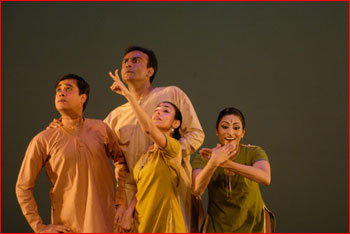
the festival. Harikrishnan's presentation of his contemporary choreography was really interesting. Dancers who straddle two cultures have these dichotomy I guess about going back to a period earlier than the roots and working at re-establishing a lost tradition while being extremely adventurous in contemporary choreography. One afternoon slot was set aside for dancers in the US among whom Payal Shah impressed both with her contemporary dance and her traditional Kathak.
Priyadarsini Govind's recital Leela Samson's choreography Spanda was also received with rounds of applause. True to her conviction, Leela does not have a central role for any dancer and the movements speak of the Kalakshetra precision with dashes of humour and fun. But monotony also sets in . . . Rasa a work in progress - was presented by Kumudhini Lakhia and Hema Rajagopal. Very interesting contrasts in Bharathanatyam and Kathak styles. Krithika Rajagopal showed great energy and stamina in taking part in the three Rasa depictions with Hasya being a bit too long and in the Red Earth and Pouring Rain tribute to the late poet A.K.Ramanujan - performed with Anita Ratnam. Rajika Puri presented her Flamenco natyam as a comparative study with Bharathanatyam - demonstrating that abhinaya pieces are also there in Flamenco. We were disappointed that scholar Kapila Vatsyayan could not be present here. Uttara Asha Coorlawala, Anne Marie Gaston and Sunil Kothari made up by talking about her contribution. There was also a charming short video clip of Kapila getting up to dance at a seminar. The last panel discussion was on making Indian dance main stream. The
panelists included writers and organisers and it seemed to me that I was
hearing the same words that are spoken at such meetings in Chennai . . . | |||

| • Back to Columns |
| • Your Contributions |
| • Your Comments |