| |||
| Celebrated dance guru of the Kalakshetra tradition Sarada Hoffman |   | ||
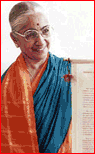 Sarada Hoffman, celebrated dance guru of the Kalakshetra tradition, was the chief guest at the function held in Krishna Gana Sabha, T. Nagar, to confer the Nritya Choodamani title on dancer Urmila Sathyanarayanan. Below are extracts of the speech she delivered at this function. Sarada Hoffman, celebrated dance guru of the Kalakshetra tradition, was the chief guest at the function held in Krishna Gana Sabha, T. Nagar, to confer the Nritya Choodamani title on dancer Urmila Sathyanarayanan. Below are extracts of the speech she delivered at this function.
The idea of an Art Festival was started in early nineteen forties by Rukmini Devi at Kalakshetra, Adyar. Later the Sabhas caught on to this idea and you all know what happens in this city when the month of December begins. Looking back, we cannot forget the eminent artistes whose concerts and dance programmes attracted large crowds of people to witness and be uplifted by the quality of the arts. It is important to remember while presenting art programmes that we keep our Indian character in our classical arts They have a rich tradition and a quality to enrich peoples lives with beauty. Our Indian culture and philosophy has always shown the way to go within to discover the divine. Every aspect of our Indian life emphasized this same principle. But gradually we have moved away from this thought to giving importance to exterior presentation only. In the present, I find there is a lot of enthusiasm for creative work especially among young artistes. This is good for imagination. The interest for newness has produced a variety and not much quality. New thematic presentations should not become an exercise for the intellect but must be a way to appeal to the heart. When Rukmini Devi took up dancing, she brought her keen sense of aesthetics to Bharata Natyam and in reforming it she also suppressed the sensual aspect of the dance in favour of a purer, more spiritually oriented presentation. This style is sometimes criticized as prudish and censorious, but in reality it did not arise from inhibitions. It was done with a purpose and was consistent with her background and priorities which valued the development of the human soul more than the entertainment of the human senses. Her refinements of the dance form were intended to elevate both the art and the audience. Hear her explain the power of dance in her own words:"The dance is an expression by the physical body. Because it is a physical expression it is both a dangerous and a magnificent instrument. The weakness of the physical body is its coarseness and vulgarity. For those who in their minds and emotions are unable to transcend the physical, the dance can become an instrument of sensuality and coarseness. But, on the other hand, for those who have a higher-knowledge, the body can fulfill its highest Dharma not only by giving to the world an expression of physical grace and beauty, but by giving through the very physical being itself an embodiment, an expression of the Cosmic Being. Therefore is it that emotion has a very high place in the dance, for emotion directs the message of grace and rhythm. In Bharata Natyam, Bhava is considered the heart of the art. Many consider Bhava to be the ability to portray emotions. This is true, but Bhava is more. It is the essence of intellect as well and there is Bhava as much in Nritta (pure rhythm) as in Abhinaya (expression). People often think that the Tillana, or the Tirmanams with Adavus and intricate foot work, are an aspect of Laya or rhythm, and therefore bear no relation to Bhava. In reality there is the Bhava of the body as much as of the face, the expression of music as well as of the emotion. In order to accomplish this perfect blending of the body, the emotions and the intellect there yet is needed knowledge, a knowledge not only of the books which in India are unique, but also a knowledge of the great philosophies, literature, poetry, music and religion, a knowledge by which the mind transcends itself in the world of wisdom. When this is achieved, Bharata Natyam is justified by the dancer, and it becomes a perfect expression of the will of the Divine; the dance becomes a Veda and the dancer a Yogi." The implication is that dance can be a means for spiritual growth, and transcendence beyond the body and mind. When a dancer can express the divine, there is true freedom of expression, for the divine embodies both base and noble, sensual and pure, without being tainted by either. Until a dance is firmly established in this path, sensuality can be a trap that prevents the realization of the full potential of dance as Yoga.
| |||

| • Back to Columns |
| • Your Contributions |
| • Your Comments |