| ||||||
| Different Strokes at Opera House, Sydney Contributed by Sumi Krishnan |   | |||||
|
Rhythm Spectrum, an In Concert Music & Pallavi Production, strikes a chord with its audience, in its first ‘Master’ concert series, on March 2, at the Utzon Room of the prestigious, Opera House Sydney in Australia. | ||||||
|
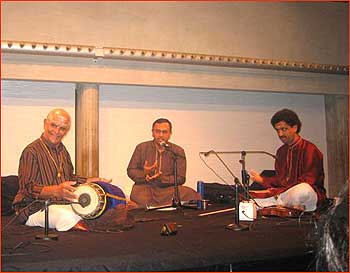
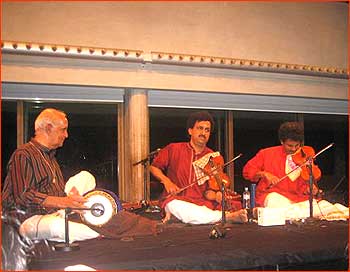
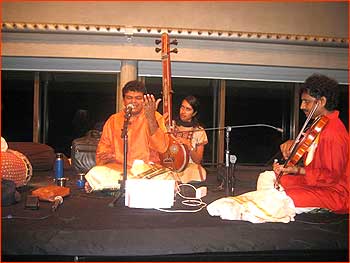
Visiting the Opera House in Sydney is a humbling experience. Even as you walk up its wide steps, the environment is set and captured. Sitting below the concrete columns that rose above, with the back drop of nothing other than a 360 degree view of the Sydney Harbour of the Utzon Room, the audience waited expectantly. As the unassuming mridangam maestro Umayalpuram K Sivaraman strolled in, the stage was set for both a visual and an acoustic treat. Sivaraman’s solo Mridangam rendition commenced with the Roopaka Thalam set to a slow speed. He explored the various nuances of the Thalam. The variations that gradually followed wave after wave were executed with arithmetic precision, of such ease and enjoyment, that it was to witness a genius at work. The rhythmic recital comprised of a production of several sounds peculiar only to the Mridangam. The audience heard the genius at work, walk, dance, and sing the rhythm. But could we hear ‘the talk of the rhythm’ as well?. This was to be witnessed in the second section of the concert. The second item for the evening was the ‘talk of the Mridangam’. Traditionally called “Konnakol,” Sivaraman introduced his student Sridhar Chari inviting him to present this section. While Sridhar Chari recited the beats, Sivaraman sang a pallavi line “ Muruga Shanmugha Vadivelava, Valli Manala” set to Mishra Chapu Thalam in Ragam Sankarabharanam showing its arrangement. Violinist Nagaraj joined them. Sridhar Chari’s careful and precise verbal rendition was a new aspect to rhythm presentation that is not often witnessed in Sydney and was indeed a novelty for Sydney siders. The violin virtuoso’s Mysore Brothers, Nagaraj and Manjunath were next on the menu. Showing the other side of the spectrum of Carnatic Music, namely melody with generous potions of harmony, this section of the concert commenced with the traditional rendition of a Varnam in Abhogi Ragam set to Adhi Thalam, followed by a Thyagarajah Kriti in Ragam Asaveri. The highlight was however the absolutely wonderful heart wrenching rendition of Ragam Mohanam in Thyagaraja’s Kriti “Nannu Palimpa”. The Mysore Brothers showed their individualistic interpretations of this Ragam showcasing their own differing approaches. Formatted in a Jugalbandhi style of rendition the three artists, Mysore Brothers and Umayalpuram Sivaraman, concluded with alternating kalpana swarams finishing in a climactic crescendo. The audience lapped up the “Jagadhodharana” that flowed after as it hit the walls of the Utzon Room. Young vocalist T M Krishna who was quietly watching this from the front line had to therefore follow this mood already brilliantly set by the preceding artists. He successfully launched his part of the concert where the Mysore Brothers had left off. Commencing a Ragam Thanam Pallavi in Ragam Thodi set to Adhi Thalam. The choice of this ‘ghana’ ragam for the evening showed that there was to be nothing frivolous about this evening’s concert, in keeping with the standards that Pallavi takes pride in setting. Throughout these sections, the one common and important factor was the essential play of rhythm. Not far from where we sat, a whole other nation was watching another equally exciting play held at Stadium Australia between the Waratahs and the Force concluding to a draw. So it was that the audience in the Utzon room witnessed the Ball of Rhythm held in the hands of the great rhythm master, Umayalpuram Sivaraman being expertly passed around between the teams of Sridhar Chari, Mysore Brothers and T M Krishna. It was equally exhilarating and a rare one at that. Who won? Why don’t you take a guess… |
|
|||||