'Chengleput' Ranganathan had the unique opportunity to learn Carnatic music from illustrious people. Vocalist Alathur Venkatesa Iyer was one. The other - the famed vocalists, the Alathur Brothers. Under both gurus, Ranganathan followed the traditional gurukulavasam system of learning. Known for his expertise in pallavi singing, the Chennai-based Ranganathan is sought after by scores of artistes. To add to the many awards he has been conferred with, the title ŒLaya Kala Nipunaı by the Percussive Arts Centre, Bangalore, at its silver jubilee celebrations in June this year. He is presently serving as the principal of Teachersı College of Music at The Music Academy, Chennai. In an interview, Ranganathan talked about the days of his learning, the style of his teaching and 'pallavi' singing.
He spoke with Revathi R. of KutcheriBuzz.
Take us back to your days of learning. . .
Initially, I learnt from my mother Rajalakshmi. Then from 'Flute' Ramachandra Sastry. Later I was put under the Alathur Brothers. I came under Alathur Venkatesa Iyer, father of one of the 'brothers' (actually, they are not brothers; they learnt under the same guru and performed together), within a short period. It was traditional gurukulavasam, serving the guru in all his daily chores and learning when the guru had the mood to teach.
Tell us more about the 'gurukulavasam' . . .
As a child one does not understand the benefits. But it helps the student to have a matured perception of life and career. One has the opportunity to listen to the guru in his best moods and listen to dialogues with visiting musicians. Our guru used to discuss the various aspects of the concerts we listened to. I had no time to think whether I liked it or not. We even accompanied our guru to outstation concerts.
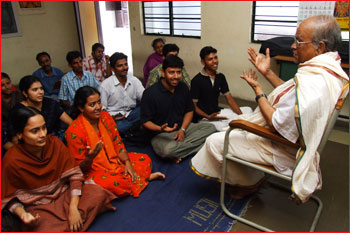
Is the pattern of teaching and learning different today?
I don't think so. The present generation is capable of learning many things at a time. Teachers also understand the necessity of their academics. They (students) have the chance to learn from many teachers. Instead of staying with the guru, the students record and take the lessons with them in audio formats. They learn at their leisure. An hourıs class later becomes a full dayıs learning through the recording. So the time of learning and practice is almost the same.
How should a student practice after learning from the guru?
Practicing techniques are same from our days of learning. The initial lessons - sarali varisais in four kalams, varnams in two kalams, akaara, ikaara and ukaara sadhakam. We practiced for many hours. In todayıs world of many preoccupations, you can do it for two hours a day. The student knows his or her sruti these days and sets the voice accordingly. We had to be guided in those days!
When did you start performing?
At the age of 14. I had my arangetram at the Nerur Sadasiva Brahmendral Utsavam. My guru Alathur Venkatesa Iyer played harmonium and Ramanathapuram M. N. Kandaswamy played the mridangam. My guru knew to play the instrument. I wish I had also learnt to play an instrument.
Does learning to play instrument help in vocal singing?
Yes, definitely you have an advantage if you know to play a musical or percussion instrument. Percussions like mridangam will give you better tala gnanam (knowledge of rhythm) and instruments like violin and flute will give you knowledge about jaaru (notes played without separation or with a single bow). Knowledge of playing veena will teach you to sing soulfully. Your vocal performance will be different from others if you know to play instruments.
You have been acknowledged as a 'pallavi' expert. How did you get interested in it?
Expert? Rasikas say this from their point. Of course the Alathur School has a lot of vyaharams (intricacies) and kanakku (calculations). Maybe, I imbibed my guruıs interests! But in my own interest, I have composed about 50 tillanas, set tunes for about 150 Tiruppugazh verses and set music in 72 melakarta ragas for Tiruppugazh. There is nothing called specialisation. I feel I am yet to learn a lot in music.
Is singing a 'pallavi' difficult?
Not at all. You should have interest in calculations. Thatıs all. In those days many did not attempt this thinking that it was difficult. Now, many artistes show interest in learning to sing pallavi. You should practice 35 tala alanakarams in four kalams.
When should one attempt singing pallavi?
Ideally after learning about 20 varnams and 100 kritis with many sangatis and in two kalams one will be able to sing neravals and swarams. Once you are comfortable singing neraval and kalpanaswaram, you can start with simple pallavis, then move to four kalai and move on further.
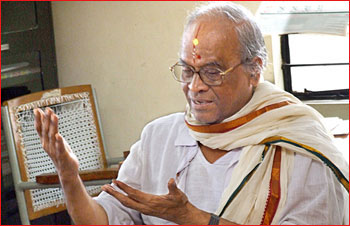
Are there any books to follow? How far theory of music is helpful?
One can follow the books only after learning the basics thoroughly. You can just learn what the teacher teaches and improve it without the help of books too. Theory helps in knowing what you sing. It is up to your interest to learn theory of Carnatic music. More than books and theoretical knowledge, listening is more important.
You mean listening to concerts?
Not only concerts. Also listen carefully to your own guru singing and to the recordings of learned musicians. We used to wait for a concert to happen during our gurukulavasam days and would be present in all the concerts - Ariyakkudi, Madurai Mani and many. Later we used to discuss about what we observed in the concert. It helps you to understand the various styles of raga handling in different schools, manodharmam (creative phrases) by different artistes and form your own style, later.
Is there a 'Chengleput' Ranganathan style of singing?
I sing and teach the way I learnt from my guru. It does not mean I imitate my guru. He was dead against imitating any style. The base is the same and we, the students improved on it by practicing by ourselves and with other musician friends. The well-known vocalist Thanjavur S. Kalyanaraman, who was a student of GNB and I used to practice together. We discussed with other friends like P. S. Narayanaswamy and T. R. Subramaniam. Those are unforgettable moments.
In this college (of The Music Academy) you now teach students who want to become teachers. What should a teacher take care of, while teaching music?
They should judge the capability of the student and teach in proportionate quantities in each hour of learning. The teacher should help in developing the creativity of a student. The traditional method of teaching the basics of Sarali, Jantai and varnams should not be diluted. Though I simplify lessons according to todayıs situation, I pass on atleast about a fourth of difficult exercises I learnt to my students.
About your students...
Among many others, Seetha Narayanan learnt from me. Mani Krishnaswamy trained under me for about 30 years. Many youngsters like Srividya Ganesan, the Sai Sisters learn from me. Many come for learning pallavi aspects.
Your family...
My wife is interested in Namasankeerthanam. My two sons are flutists, students of K. R. Ganapathy.
As a teacher, what would like to share with students of Carnatic music?
Practice, practice and practice. Follow your teacher closely. Occasionally you may find rare tips to pick up. Practice singing each sangati 50 times. It is difficult, but if you want to perform well, this is the only way. No short cut. Listen to concerts of senior artistes as well young artistes. The more you listen, the better you perform. Even after getting on to concert platforms, keep adding to your stock of kritis and varnams.
Chingleput Ranganathan resides at 13/6, 'Karthik Flats', Nallappan Street, Mylapore, Chennai-4. Ph: 42175165.