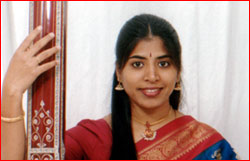
This unique RTP concert was dedicated to Gottuvadyam Narayana Iyengar on his 103rd birth anniversary. Kiranavali chose a pallavi in the ragam Shanmukhapriya set to Adi talam. She rendered the raga alapana in Shanmukhapriya and tanam in five ghana ragas- Nata, Gowla, Arabhi, Varali and Sri, apart from the main raga. The neraval portion had five more major league ragas, Harikambhoji, Poorvikalyani, Shuddha hindolam, Kalyani and Bhairavi. Followed by the slow and fast swaras, was the exciting part of the concert, the kuraippu swaras in 72 ragas. In the last 1/8th round of kuraippu, the artiste performed only the arohanas of the ragas taken for the round, which was enough to show to the character of the raga.
The grand finale was the garland of ragas with names whose first syllables, when strung together, got the name 'ashta uttara shata ragamalika pallavi. This section include rare ragas like Tapasvini and Lingapriya.
Kiranavali spoke to Revathi R of KutcheriBuzz after this concert of a 'marathon pallavi'.
What motivated you to take up a 108 raga pallavi?
I remember hearing a small bit of a recording of Dr. L Shankar in my childhood. It used to be a favorite of mine. I can't recollect all the details of that recording, partly because we didn't have the full piece. But I distinctly remember the climax, which was this brilliant round of swaras culminating in a ragamalika, where ragas changed every moment, giving a kaleidoscopic effect. The ragas were all audava (ragas containing 5 swaras), and with a change of just one swara, the next raga was brought out! Needless to say, this is a really challenging and facscinating exercise, and I have always wanted to do it one day. My brother Ravikiran has rendered 100-raga pallavis on two occasions before, and I have also sung a 101-raga Pallavi concert in Los Angeles in February 2004. This time it was at the behest of Mr. Muralidharan of Chennai Fine Arts that I chose to sing a 108-raga Pallavi.
The sheer joy of working on something different and challenging is a big inspiration for such ventures. Attaining some level of clarity and perfection especially while executing the 1/8th kuraippu swaras is also a highly satisfying exercise. In general, I always like to keep stretching myself, be it for my music or anything else I do.
What is the basis of selection of ragas for the pallavi?
I had to mainly work backwards while choosing the ragas. I first chose the ragas for the 1/8th kuraippu swaras as this was the one that needed ragas that could be brought out in a few moments. For example, Kuntalavarali's arohanam is very distinct and and brings out the raga with the simple phrase Sa Ma Pa Ni Da Sa. The same can be said of Niroshta (Sa Ri Ga Da Ni Sa). After the 1/8th kuraippu swara ragas, I chose the 1/4th kuraippu ragas. Here I had more time, and could indulge in heavier ragas like Begada, Dhanyasi, Saveri and Atana which have a very distinct flavour, and can be brought out in a characteristic phrase. The next was to choose the ragas for the grand finale. Here the key was ragas the first syllable of whose names would bring out the words "Ashottara-Shata Ragamalika Pallavi". It became easier after this, as the 1/2 or 1 avartana kuraippu rounds give a lot of room to bring out the flavour of any raga.
How long did you practice for this pallavi?
When I did the 101-raga Pallavi in LA, I practised for about 3-4 weeks. This time I worked for about a week. But I did a lot of mental practise, going over the especially challenging parts repeatedly.
Wasn't it difficult to remember the order of ragas?
Generally, things register well with practise, which also stimulates your imagination. Of course concentration is a must!
We did not hear of this concert during the December music season!
I wanted this unique pallavi to be distinct and hence chose to sing after the 'season'.
What are the plans for next year?
I am interested in such attempts, but I'm equally interested in traditional concerts. I have had the opportunity of understanding and enjoying the vastness of Carnatic music from my father, Chitravina Narasimhan, who is a master in all its various aspects. Be it ragam singing, rendition of a weighty kriti in all its beauty and grandeur, or singing the lighter musical forms, he is an adept. I have never heard anyone sing better Tanams than him. When it comes to kalpanaswarams, he is as good at singing the sarvalaghu swaras as he is in kanakku swaras. As for Pallavis, he has come up with several interesting concepts besides creating a whole lot of them in simple and complex talas and forms. From Brindamma, I had the opportunity of learning many exquisite but forgotten kritis, padams and javalis. I am keen to present these as well. In fact later this year, I have been requested to give a concert exclusively featuring padams and javalis and I am really looking forward to it.


