|
Bharatanatyam has many young faces from different schools now. Among the young dancers who have made a mark is Chennai-based Sheejit Krishna.
This alumni of Kalakshetra, Chennai, has been recently awarded the Ustad Bismillah Khan - Yuva Puraskar, a new award introduced this year by the Sangeet Natak Akademi.
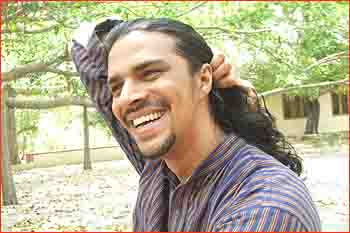
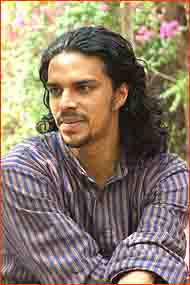
Sheejit teaches at Kalakshetra today.He has many faces - as dancer, choreographer, musician and a teacher. In this interview with Revathi R. of KutcheriBuzz, Sheejit shares his experiences at Kalakshetra as a student and now as a teacher and his passion for music and dance.
 You have just come back from an overseas tour. What was it about? You have just come back from an overseas tour. What was it about?
This trip was to Kuwait. I went with a few of my students. The students performed a recital. Also dancer Shijit Nambiar, who trained in Kalakshetra as well under me, choreographed and staged a production titled ‘Krishna’. For this production I did the nattuvangam. I travelled with the group to provide the nattuvangam and for a lec-dem on dance. We were in Kuwait for five days.
What was the lecture demonstration on?
It was based on Bharatanatyam. In fact, it started from how man began to dance from a mere jump. The lec-dem was for students of class 5 to 9. So it was on the basics of dance. We began from the folk dances. We really took them to the stone age! And explained to them how the dance has acquired a civilised form in course of time and how Bharatanatyam has shaped into its present form.
You are a teacher in Kalakshetra. When people invite you from the other parts of the world, what do they expect form you?
They expect more on the dance style of Kalakshetra and the way we teach the art here in the campus. In Kalakshetra, it is taught as a complete form of art. It is based on the ideals of Rukmini Devi. Dance is not merely about shaking your limbs. It is something more than that. She has purified the art form, I would say. She removed the vulgarity in dance, I personally feel.
Kalakshetra’s main mottos are: art without vulgarity, beauty without cruelty and education without fear. They matter most in Bharatantyam as well.
Tell us about your early days of learning dance.
I learnt dance initially from my parents - Kannanur Balakrishnan and Manorama Balakrishnan. I wanted to become a mridangist. And then a musician. Dance was third on my priority. I have a passion for classical music and mridangam. Of course, now I do all the three - music, mridangam and dance. I learnt mridangam under maestro ‘Vikku’ Vinayakram.
How do you think that Kalakshetra has shaped you?
I joined Kalakshetra in 1989 as a student. I can’t compare the education at Kalakshetra with whatever I learnt earlier. Actually, for anyone who enters Kalakshetra, the beginnings are made here. Even if they had had their arangetram earlier, they start their alphabets in Bharatanatyam here. For three years I trained under Sharada Hoffman. A sincere teacher, Sharada made us learn a lot of things. It used be tiresome in those days. But now I realise that I really learnt many things from her.
While doing my post graduation, I trained under Krishnaveni. Being in Kalakshetra, I cannot say that only these two are my gurus. In dance productions, Janardhanan, Balagopal and many senior teachers also taught us a lot.
At Kalakshetra, learning is not only in the classroom or of the subject but the entire Kalakshetra becomes your teacher. Padmasani and Sankara Menon were the people who even looked after the creepers and plants inside the campus. Sankara Menon used to deliver a speech during the prayers every day. Life at Kalakshetra makes one a complete artiste. It is not just about any specialisation in this institution, but it is about life, you learn here. Ultimately as a student, we learn to realise what life all about. This is my frank opinion and not for the sake of conversation. I mean it. This campus has moulded me to see life differently.
Tell us how.
We learnt about stage décor, music for dance, curtains for the show, the costume we should use. Whatever we at Kalakshetra use looks aesthetic. And when I see some odd décor and colours of costumes on any stage that don’t suit the dancer or the character, I feel that this will not happen with the Kalakshetrians!
Now as a teacher, I advise my students not to merely learn what I teach, but observe all that happens around them in this campus, which will teach them a lot. A simple ceremony at this campus will be different from others. That’s the tradition of Kalakshetra.
Do you see any difference between your student days and now, on the campus?
The change is only my experience and in only what I try to do. The ideals are the same. Though there are changes over a period of time, they are for better. After the present director Leela Samson took charge, there have been changes. Changes are bound to happen in any system. But the fundamentals are not affected here.
As a teacher, I meet students of all categories and with different capabilities. To me, it appears that all students leave something behind at this institution when they move on after completing their studies. Every batch is a different experience for me. And according to me, the real talent of a teacher is to identify the different abilities of his students and guide him or her.
 You said that the changes are for better. Do you follow the tradition of Kalakshetra in your teaching and performance or do you also experiment? You said that the changes are for better. Do you follow the tradition of Kalakshetra in your teaching and performance or do you also experiment?
Definitely, the Kalakshetra tradition is our base. But we are trying to do something more out of it. The way we look at the theatre and the art as a whole is different now. I do a lot of work with the final year students of the post-graduate course. They come to theatre for concerts. I am present there as a dancer, as a teacher. But I do give a few ideas about the lighting. With more facilities available and with the advancement in technology, we try to bring out the art in a better form. Without spoiling the ideas of Rukmini Devi, we do a better presentation of the productions.
Does the improvisation apply to your own productions or to the Kalakshetra productions as well?
It also applies to the productions of Rukmini Devi! For example, the Ramayana, choreographed by her, now includes our ideas too. For the new productions we borrow the ideas from what she has choreographed and performed. The tradition supports us well, though the productions now have a new version of choreography.
What is your present focus? Is it on teaching or new productions?
I enjoy teaching. While teaching, we learn a lot. Though many say this, I really feel it. For my solo performances, I get very little time to practice. But I feel that I get 95% of the practice from my teaching.
Besides teaching. I choreograph. Mainly for dance dramas. ‘Marthyan’ was my first. I did it when I was a PG student here in Kalakshetra. That was about the evolution of man. The ultimate message of the dance drama was to share and feel togetherness of human beings and live in harmony.
My second one was ‘Swapna Rag’. It was a musical dance drama. A story based on seven characters representing seven musical notes. I depicted ‘Sa’ as earth, ‘Ri’ as nature, ‘Ga’ as human, ‘Ma’ as history, ‘Pa’ as Shastram, ‘Dha’ as a villain human, ‘Ni’ as dream The theory of 72 melakartha ragas was presented through this production. One who knows about the katapayadi formula and the melakartha scheme of ragas, may understand the musical theory in the dance drama. Every character sings alapana of a janaka raga. When the ‘dream’ comes on stage, the character carries the janya ragas. It is a beautiful one.
Why did you choose music as the subject for this production?
Of course, it is my passion for music that made me come out with an idea like this!
What are you working on now?
A new dance drama again. It is titled ‘Masquerade’. It is based on Alexander Dumas’ novel ‘Man in the Iron Mask’ The three musketeers appear in his fiction. I started thinking of it out of my own interest like my other two earlier productions. When Leela Samson and I were travelling from Mangalore, we discussed this idea. She showed interested in the idea and asked me to do it as a Kalakshetra production. It is a credit for me that she recognised my idea and talent.
Tell us more about this new production . . .
We are bringing real theatre into it. Drama and dance come together. There are a lot of dialogues. We are using proper theatre techniques. In fact I am growing my hair for this new production! I am doing two different characters. Praveen of 'Magic Lantern' theatre group is also guiding us in the new production. This will be staged by the end of September this year.
Do you take dancers from other schools for such productions?
For this dance drama, all the dancers are from Kalakshetra, because it is produced under the institute’s banner. There are very good dancers on campus. For my own productions, I do take students and dancers from other dance schools.
With the 'Yuva Puraskar' award, you have been recognised as a talented young dancer at the national level. How do you feel?
I am happy about this award. I have heard that we have to ‘apply’ even for awards. As this is the first time that the Sangeet Natak Akademi has instituted this award in the name of Ustad Bisnillah Khan, no one knew that such an award and I am happy that they have recognised me and my art. I never apply to sabhas for performances. On one side I’m lazy. And on the other, I don’t believe in ‘applying’. Being a Kalakshetrian, I have a lot of exposure here. If I was a student of a private teacher, I definitely would have to 'apply' for performances. But, as I have given many performances and have done most of the leading roles in the productions of Kalakshetra, I am well known to my fellow dancers and the organisers.
The trend has been for artistes to pay and perform. I don’t really like it. And I don’t want to be part of it. Rather, I enjoy doing choreography and working in groups.
What has been your experience in productions of others?
Though I enjoy group productions, frankly, I am not being invited to dance in others' productions any more! The groups perhaps hesitate to ask me because I am a choreographer myself and they may wonder if I would dance for their choreography! But I enjoy dancing if I am invited to. I have worked with the Narasimhacharis in their production ‘Ainthinai’. I have worked with the Dhananjayans and C. V. Chandrasekar too. I think other choreographers today feel that I have become a choreographer and am no more a small dancer. I feel sad about this - that I am not called to perform in other productions. I encourage my students to join other groups.
I feel that once in a while we choreographers should work together. With the different talents in choreography, we can create magic.
Where do you want to go from here?
I am waiting to finish the big production I am working on. My ambition is to do more musical productions. Recently, with Suhasini Thomas of Kalakshetra, we produced 'Ramayanam' using bhajans and not traditional songs. O. S. Arun sang for us. It was a two-hour performance. I am planning something very musical, but not quite thematic. I enjoy the music in dance. For our shows, I don’t go for a mediocre singer for the orchestra. I like to have a really talented singer, whose talent in music is more than that of the level of the dancer.
My musical production, ‘Swapna Rag’, was for an hour and produced for ABHAI ( Association of Bharatanatyam Dancers of India). I am planning to do a longer production. Say, for two hours. For this I want to have someone who sings not just for dance, but as in a vocal concert.
The trend in dance is that, if you know to sing a few kritis, you can sing for dance concerts . . I feel this should not be the case. I observe in many dance recitals, the singer doesn’t sing the alapana of ragas. Either the flutist or the violinist does that. Perhaps it is because the singer does not know to elaborate a raga! The singer should be well versed to sing many sangatis.
If the singer does the improvisation on the spot, don’t you think that it will be difficult for the dancer to do abhinaya on the stage?
In fact, I have done one like this – for music on the spot. It was for Natyarangam’s 'Layabharatam' series. I presented the kriti ‘Palinchu Kamakshi’ composed by Shyama Sastry. I told my musician that this was the kriti I had chosen and allowed him to sing in his own way. It was not rehearsed. I also let the mridangist and the thavil vidwan take the tani avartanam as they would do in any vocal concert. The vocalist did the manodharma swaras also. I did not know how many times he was going to repeat the line, where he would sing the kalpana swaras and at which point the percussionists will take tani avartanam. I was blank at some points because there was no preparation! Yes it was a nice experience.
Yes, music is performed on the spot. And dance is rehearsed well before the performance. But we do have rehearsals with the musicians also. However, the limited knowledge of the singer restricts the imagination and the creativity of the dancer. If the singer knows well the structure of a raga like todi, he or she can sing one particular line of a composition in different ways, with different sangatis (repetitive singing), and the dancer gets more ideas! Generally, the singer just sings the lines he or she has leant by heart. If the vision is to go beyond this, it is good for dance, good for dancers.
I think it is time for dancers and musicians to get together!
|