| ||||
| Content in Indian classical Dance By Aruna. S / reported from Bangalore |   | |||
| The chilly weather at Karnataka's Garden City is a welcome break for any Chennaite. And its not just the climate, the greenery, the broad roads, the many pubs and eat-outs or the soft spoken Kannadigas that cosmopolitan Bangalore boasts of. The city is also vibrant with music, dance and South Indian culture...
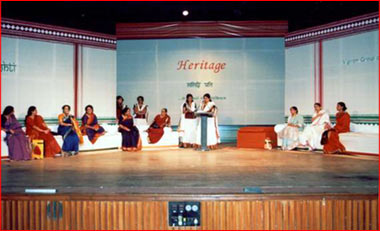
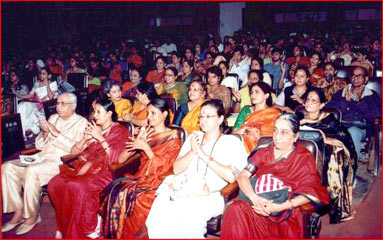
On Sunday (1 August), the dance community of Bangalore that filled Ravindra Kalakshetra's huge auditorium at J.C. Road, said it all. Luring dancers and rasikas from all over Bangalore was a day-long seminar on classical dance. Organised by Heritage, a ten-year old charitable organization recognised by the Govt. of Karnataka, the seminar was supported by Drishti, an art magazine and the Vigirom Group of Companies. The Heritage team seemed to have been inspired by the 'mayilkan' dhothi with its typical maroon and green border. Right from the brochure to the stage decor, even the gagra cholis that the organising team was clad in, were themed on the 'dhothi' colours. 'Classical Dance in Changing Times' was the theme of the seminar. Says Vijayalakshmi Vijayakumar, Secretary, Heritage, "It is the content in Indian classical dance that we wanted to look into. Its significance in the past and its significance to the dancer and audience of today..." The inaugural address was delivered by renowned dancer Sonal Mansingh, Chairperson, Sangeet Natak Akademi. "Dance makes all philosophical thoughts alive. It is a leap within that reflects in a dancer's performance..." she said. In the Chief Guest's Address, Swami Dayananda Saraswathi simply let his thoughts run for over half an hour, slightly off beat at this seminar. Content in Indian Classical dance
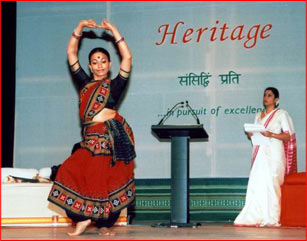
'Significance of content to the dancer of today' was presented in a nutshell by Chennai based Bharatanatyam dancer Priyadarshini Govind. "Old varnams never die with over exposure, but mellow like fine wine..." said the dancer who also shared her views on 'Margam', the traditional format of a Bharatanatyam recital versus thematic dance features. Dancer Minal Prabhu, who runs Mudrika, a dance school in Bangalore spoke on 'Content for the audience today'. "Younger dancers need conviction about what they perform and should not just duplicate their gurus. Ambition without dedication is short lived. A dance performance should touch the heart...it is in the hands of the dancer and the rasika" she said. The second session of the seminar focussed on 'The change in form and format'. Senior dancer Dr. Padma Subrahmanyam delved in detail on why she named her style of dancing as 'Bharatanrithyam'. "Some people called my style of dancing as 'Padma Natyam'. When they found my style of dancing which is based on the Natyashastra, to be different from Bharatanatyam, I had to bring in a change in the nomenclature". She also said that Tamil Nadu would soon have a temple for Bharatha and invited dancers to pay their homage there. Bangalore based Odissi dancer, Surupa Sen went into the history of Odissi. Dancers of the Nrityagram dance ensemble demonstrated the basic steps in Odissi formulated by the Late exponent Kelucharan Mohapatra and the new movements in Odissi introduced at Nrityagram by young dancer Bijoini.
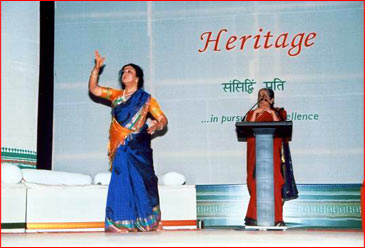
The differences between the old and the new style of dance movements in Kuchipudi was explained and demonstrated by Bangalore based dancer Vyjayanthi Kashi. She spoke about the transformation that has happened over the years in Yakshagana, Kalapams and the solos in Kuchipudi. Guru Maya Rao of the Natya Institute of Kathak and Choreography, Bangalore elaborated on how Kathak has been adapted to the stage today, from its earlier practice at the different gharanas. Dancers of the Natya Institute demonstrated the differences between the old and the new style. Role of classical dance
This commenced with a paper on 'Classical dance and society today'. As Dr. M. Surya Prasad, Editor, 'Gunagrahi', Bangalore was unable to be present at the seminar, his paper was read out by a Heritage team member. Surya Prasad had highlighted the need for cultural impressarios and a cultural policy in India. Gowri Ramnarayan, Arts Journalist, 'The Hindu', presented her views on 'Dwindling Audiences for Classical Dance'. "Look out for new venues", she said. "When we talk of audience, we only think of closed air-conditioned auditoriums. Why not move to outdoor spaces. Temples, parks, schools, colleges and several other open-air public spaces can be used." Commenting on dance music, she said, earlier we had musicians whose singing was 'bhava' laden and complimented the dancer as she performed. Today we have vocalists who look at the paper and hardly watch the dancer. "On the part of the dancer, we've lost out metaphors in abhinaya". Mechanical portrayal of stories have come to stay, without a deeper understanding, she felt. The concluding presentation was by senior dance guru Chitra Visweswaran on 'Traditional role of classical dance'. She said that the word 'traditional' itself is ever changing. "It is like an amoeba that is constantly changing its shape for its various functions". The role of dance has been different at different time periods she felt. From mere entertainment, to a divine offering at a spiritual level, to the joyous experience of a dancer when she performs, the traditional role of classical dance has been ever changing, said the dance guru. At the open discussion, there were several questions from the young dancers and students. While no conclusions were drawn on any subject, the speakers on stage shared their ideas on the various topics discussed. It was a long day, and one wished there were three papers less at the seminar. Sometimes, too many long speeches can go above your head!
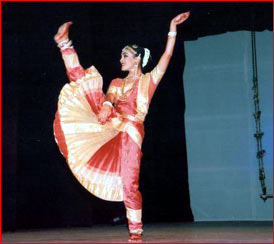
Surprising the Bangalore rasikas were gurus Kalanidhi Narayanan and Padma Subrahmanyam, who sang for each other and performed an old padam... The day-long event concluded with a solo dance performance in the evening. Themed on lord Krishna, this was presented by Rukmini Vijayakumar (a student of Guru Narmada of Bangalore) to a packed audience.
In contrast to Chennai, one saw a huge turn out of dance students and professional artistes at the seminar, considering the fact that there was a fee of Rs. 250 (general) and Rs. 125 (students) - inclusive of lunch and tea. Probably Chennai has an over dose of such seminars and lec-dems during the December Season, and that too offered free, that the dance community of Chennai takes it easy!
Parampara - Workshop for young dancers
About 20 young dancers have been attending the workshop. Guru Kalanidhi Narayanan, Priyadarshini Govind, Sundari Santhanam. Dr. Ra Satyanarayan, Dr.Ramaswamy Iyengar, Shathavadaani Dr.R. Ganesh, Dr. S R Leela and Prof.Kannan have been interacting with the participants here. Says Suryanarayana Rao, a participant, "The camp has helped me to look into the nuances of adavus and abhinaya. I'm more aware of what I perform now. I've also begun to understand the meaning of Sanskrit shlokas." Dancer Anita Santhanam says, "There has been a holistic approach to dance, music and shloka. It opens your eyes and makes you realise why you are doing certain movements in dance, the way they are done." In the last ten years, Heritage has been involved in research, art activities and community service. Besides assisting in a free mid-day meal scheme for the children of the Sakklavara Govt. School, Heritage has also presented fund-rasing shows during calamities like the Gujarat earthquake, Kargil War and the Orissa cyclone. And the dance seminar last weekend, has been one of Heritage's Art Circle's first attempts at bringing India's top artistes together on stage for Bangalore's rasikas. Contact: Vijayalakshmi Vijayakumar, Heritage, No. 1, Puttanna Road, Basavangudi Bangalore 560 004. Ph: 080-2660 4742 E-mail: heritage@yes2yoga.com If you attended this dance seminar at Bangalore, do share your views with us. Mail your comments to editor@kutcheribuzz.com Your message will be posted here. Soon on this website, watch out for an interview with Vijayalakshmi Vijayakumar of Heritage. | ||||