| ||||
|   | |||
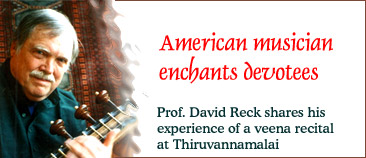
| Professor of Music and Asian Studies at Amherst College, U.S.A., Prof. David Reck is a veena artiste.
It was in 1968, that Prof. Reck first visited Madras under a fellowship from the Rockfeller Foundation. As a guitarist he had an inclination to learn another string instrument and hence the veena. In 1991, Prof. Reck got a fellowship from the American Institute of Indian Studies to specialize in the Karaikudi style of veena playing. He visits Madras almost once every year to learn this style from Ranganayaki Rajagopalan. And he has transcribed more than a hundred varnams, kritis, and tillanas as played by the Karaikudi Sambasiva Iyer tradition. He is also a regular visitor to the December Season in Madras. Recently this 60-plus veena artiste performed at the Ramanashram at the famous temple in Tiruvannamalai. He was accompanied by mridangist Umayalpuram Mali. In a column for KutcheriBuzz, Prof. Reck shares his experience of presenting a kutcheri in a temple ambience... "For the musician, performing at the Ramanashram in Tiruvanamalai is a special experience. The activities of the day, meditation, meals, chanting, ritual --is over for the day. It is evening, quiet and peaceful. The peacocks have gone to rest on the temple roof. On the moiuntainside of the mighty Arunachalam looming above the ashram the forest animals have begun their nightly foraging. A lazy half moon and stars illumininate the night sky. Time stops, or at least slows down. Devotees gather to sit between the pillars in the hall. A larger-than-life portrait of Bhagavan smiles benignly on the gathering from the wall behind the musicians. The spirit of the great rishi pervades everything: stone, air, stillness, faces, breath. The music begins. In the nuances and curves of raga, in the sublime songs of the great saints, in the play of rhythm, there is something deeply profound... In this aura of meditation, forgotten and left behind is the splash and show, and virtuosity of the urbane concert stage. The Maharishi's eternal question -- Who are you, really? -- thunders in the musician's ears. As raga follows raga something happens. The music begins to come not from the individual musician and his decades of practice, but from some place else, invisible, playing through the musician himself as if he were an instrument. In this experience - of depth and mystery-- veena and drummer, musicians are no longer separate entities: mind and heart, arms, fingers, wood, strings, wax, skin and metal blurr and merge, disappear. Artist and audience begin to breathe with one breath, with the peacocks on the roof perhaps, and the roots of trees and the rocks of the mountain, the moon and stars, floating together in an ocean of sound, a universe, which permeates yet transcends them all. You can write to Prof. Reck at veenadbreck@hotmail.com | ||||