| ||||
| Learning a varnam...
By KutcheriBuzz Staff / Chennai |   | |||
|
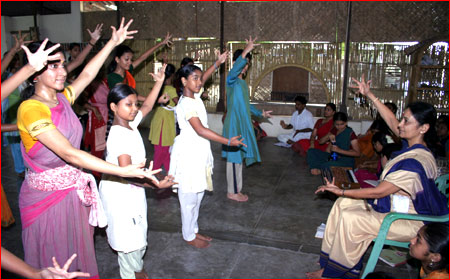
About 40 dance students of various schools, sweated it out this May,learning a new varnam at Chennai's Shree Bharatalaya. They were attending a master-class conducted by senior dance guru Prof. Sudharani Ragupathy. This was part of the annual Bharatanatyam workshop hosted by ABHAI, the Association of Bharatanatyam Artistes of India. Through the year, ABHAI hosts two-day monthly workshops, and in the first two weeks of May, a senior guru is invited to teach a 'Varnam'. The varnam is the longest and most important piece in a Bharatanatyam recital, which tests the skill of a dancer. This year, the varnam that Prof. Sudharani took up was 'Amba Akilandeshwari...' set in ragam Kalyani and talam Adi, a composition of veteran vaggeyakara and composer, the Late Vidwan Madurai N. Krishnan. This time, the workshop which culminated with a performance of the varnam, by ten dancers who attended the master-class, was dedicated to the memory of Vidwan Krishnan, who had composed numerous compositions for the Bharatanatyam repertoire. Usually, as part of the Bharatanatyam training in an institution, it takes a few months to complete a varnam, and for the student to perform it with ease after a rigorous practice. To package the same in just about two weeks, and that too for 40 students requires a different plan. Here, Prof. Sudharani shares information how she planned and designed the 'Varnam' workshop... "We had students of various age groups and different styles. There were girls and a few boys too. We had to choose a varnam that would suit everybody. Hence a varnam which had 'Bhakthi' or devotion as its predominant mood was chosen. Since, if we took up a varnam based on 'Shringara' or love as its theme, it may be difficult for children to express some of the emotions. We decided on 'Amba Akilandeshwari' a beautiful varnam which is not commonly performed. This varnam also offers tremendous scope for episodal 'sanchari' or narration of stories, relating to Goddess Devi. Each class would begin with a recitation of invocatory shlokas, followed by warm-up exercises. We distributed copies with the lyrics of the varnam, alongwith its music notation. To start with, we taught them how to sing the varnam and recite the various jathi-s (rhythmic syllables) alongwith the talam. Learning to recite the jathis is very important for a dancer. This will enable the dancer to have a grip over what he or she performs. We explained the meaning of the verses - that is meaning of each word, each line and the essence of each verse. An understanding of the meaning is very essential to portray the various emotions. In the first week, two jathi-s were taken up each day, followed by the verses and later, the swarams, followed by their verses. Initially, we taught them just the depiction of each verse, according to its word-to-word meaning. Once they had learnt the entire framework of the varnam, we went into the elaboration of each verse or the 'sanchari' bhava. Here, we almost had a story telling session, where the students would first listen to the story that was to be depicted. Then, as I depicted the same with the hand gestures and expressions, the students would first sit and perform them and then try out the actions, when they danced. Since there were about 40 students, we divided them into three batches. While one batch performed, the other two got to sit and watch the choreography and sing the varnam as well. And each batch would perform whatever they had learnt that day about three times, and in turn, it was for about nine or ten times that each piece of choreography was repeated each day. This helped the students grasp the varnam better. In the second week, it was just practice of the varnam in its entirety, alongwith the 'sanchari' bhavas." Prof. Sudharani was assisted by her senior disciples Priya Murle and Aruna Subbiah, in reciting the jathis and demonstrating the adavus and Shree Bharatalaya's music teacher T.M. Krishnaveni with the singing. On May 14, at the Mylapore Fine Arts Hall, 10 students were selected to perform the varnam at an event organised by ABHAI to felicitate the 'Kalaimamani' awardees of this year, from the dance fraternity. The ten students performed the varnam in pairs, before an audience that had senior dancers and gurus like the Narasimhacharis, Adyar Lakshmanan, Udupi Lakshminarayan, Leela Samson - Director of Kalakshetra, Anitha Guha, violin maestro Kunnakudi Vaidhyanathan and sabha secretaries R. Krishnaswamy of Narada Gana Sabha and Lion Natarajan of Nungambakkam Cultural Academy. At this event, awards were also presented by ABHAI to the men behind the stage - veteran make-up artsite Sethumadhavan, dance costume tailor D. S. Aiyellu and lighting artiste Gopi. Running around, doing all the odd jobs and co-ordinating the workshop and the felicitation event was ABHAI's secretary and dancer Roja Kannan. For more info on ABHAI, e-mail: abhai@kanini.com, Ph: 2499 4751. | ||||